

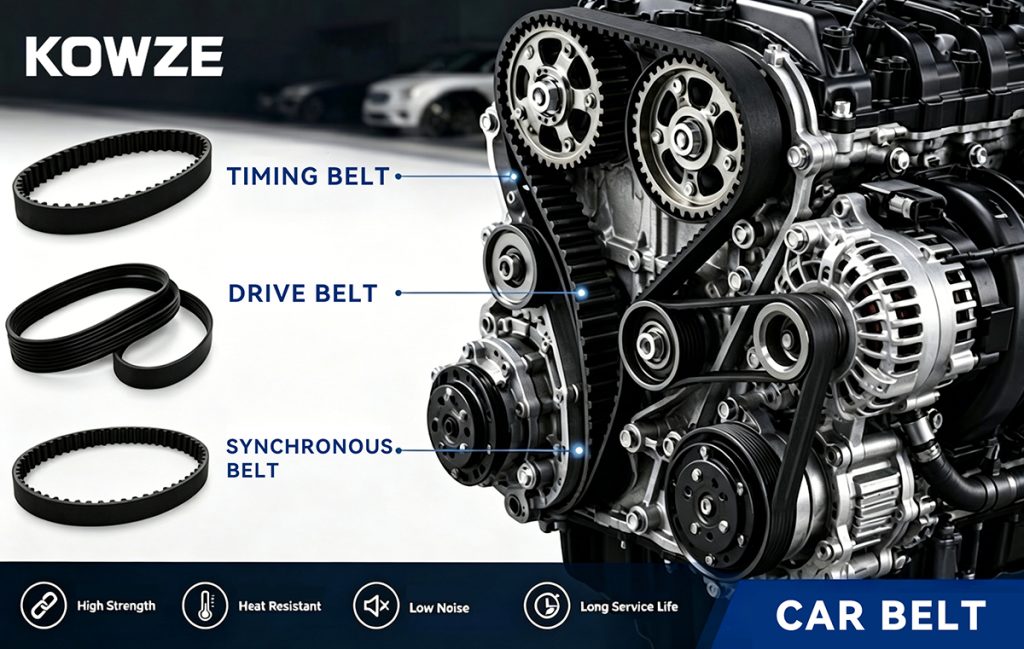
Auto belts are power transmission components made from high-strength rubber compounds reinforced with materials such as polyester fibers, fiberglass, and aramid fibers. By connecting various engine components, they transfer power and ensure synchronized operation throughout the engine system.
Depending on the vehicle design and engine configuration, a car typically uses one to three belts. These belts play critical roles in power transmission, engine timing synchronization, and accessory operation.
Although automotive belts are wear items, they are essential for vehicle reliability. A worn or broken belt can lead to engine failure, vehicle breakdowns, or even severe mechanical damage.
Types of Automotive Belts

Timing Belt
- The timing belt connects the crankshaft and camshaft, ensuring that engine valves open and close at precisely the correct time.
- Functions:
- Synchronizes engine timing
- Maintains valve operation
- Improves combustion efficiency
- Supports stable engine performance

Serpentine Belt
- The serpentine belt drives multiple engine accessories, including:
- Alternator
- Water pump
- Air conditioning compressor
- Power steering pump
- Cooling fan
- Most modern vehicles use a single serpentine belt for improved efficiency and reduced maintenance.
Synchronous Belt
Also known as a toothed belt, the synchronous belt uses precision teeth to engage with pulleys, providing highly accurate and slip-free power transmission.
Automotive Belt Materials
Standard Quality Belts
- Domestic rubber compounds
- Standard reinforcement cords
- Typical lifespan: 30,000–40,000 km
Premium Quality Belts
- Imported EPDM rubber
- Imported fiberglass or aramid cords
- Typical lifespan: 80,000–100,000 km or more
Premium belts offer superior resistance to heat, wear, and fatigue, making them ideal for SUVs, pickup trucks, and commercial vehicles. Kowze is ready to provide the premium quality belts to you!
Signs Your Car Belt Needs Replacement
- Visible cracks on the belt surface
- Severe edge wear
- The belt has become hardened due to aging
- Unusual noise during engine startup
- High-pitched squealing noise while driving
- Abnormal operation of engine-driven accessories
FAQ
Q: Can I drive with a worn or damaged belt?
It is not recommended. A damaged belt can fail unexpectedly, causing loss of power steering, charging system failure, overheating, or severe engine damage.
Q: How often should I inspect my car belts?
It is recommended to inspect belts during every routine service or at least every 20,000–30,000 km to identify wear before failure occurs.
Q: Why is my car belt making a squealing noise?
A squealing belt may indicate wear, improper tension, pulley misalignment, contamination, or aging rubber that can no longer maintain proper grip.
Q: What material is used in high-quality automotive belts?
Premium automotive belts are commonly made from EPDM rubber reinforced with fiberglass, polyester, or aramid fibers for greater strength and durability.